
Welcome to our Public Beta Site - What does this mean?
Dublin: 8 °C Monday 21 May, 2012

Rare photographs: Animals of the world’s most remote jungles

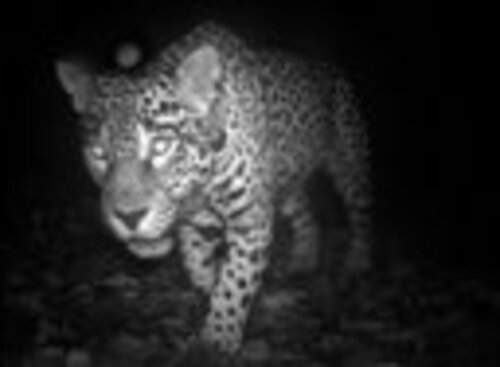
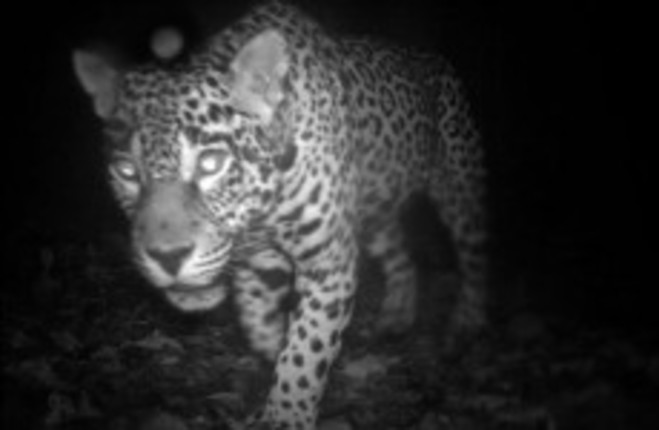
A jaguar in the Central Suriname Nature Reserve.
Image: AP Photo/Conservation International Suriname/TEAM

THEY ARE THE hidden family portraits of Earth’s most remote jungles finally revealed: a touching snapshot of an endangered female mountain gorilla carrying an infant on her back. A giant anteater sticking its enormous snout practically in your face. Soulful eyes of a curious chimpanzee, a speedy jaguar and a rare tapir staring back at you.

Researchers are getting an unusual peek into key tropical spots with 420 hidden automatic cameras snapping candid photos of the truly wild. The first of almost 52,000 pictures were released Monday by Conservation International, a group that promotes wildlife protection, and they are wowing some experienced wildlife biologists.

The cameras snapped away during a month of the dry season, starting in 2008, in seven different countries and will continue to take candids in future years.

“These kind of captured them doing what they’re doing, being themselves,” said study lead author Jorge Ahumada, technical director of the Tropical Ecology Assessment and Monitoring Network.

What’s key is that there were no people involved. The cameras were hidden with camouflage and don’t have a visible flash. They are heat-sensitive so when something warm is nearby, the camera snaps a picture. The cameras were positioned to study mammals, but also got large birds, lizards and something else: human poachers, guns in hand.

Ahumada and his team positioned the cameras in seven different wildlife preserves in Suriname, Costa Rica, Indonesia, Tanzania, Brazil, Uganda and Laos. Suriname had the most diversity and Laos the least. Their findings were published in Philosophical Transactions of the Royal Society B.

“What a great study,” said Stanford University biologist Terry Root, who wasn’t involved. “Mammals are very hard to census because they are afraid of humans and they have better ways of hiding than we have of finding them.”

- AP

Rare photographs: Animals of the world’s most remote jungles
1 / 4
  • Candid Camera Wildlife

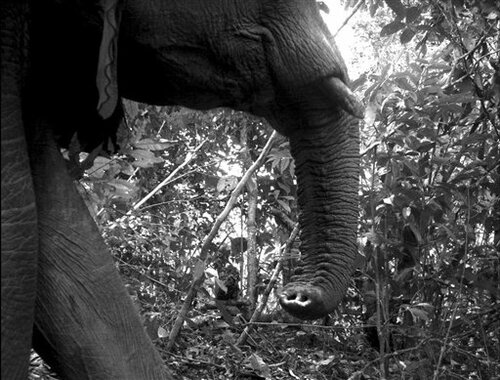
    This image provided by the Trento Museum of Science shows an African Elephant in the Udzungwa Mountains, Tanzania, on Oct. 11, 2009, and is one of almost 52,000 photos of 105 mammal species taken as part of the first global camera trap mammal study by The Tropical Ecology Assessment and Monitoring Network in 7 protected areas across the Americas, Africa and Asia. The cameras were hidden with camouflage and didn't have a visible flash and were heat sensitive so when something warm was nearby, the camera snapped a picture. It was the largest animal photographed in the study. (AP Photo/Trento Museum of Science/TEAM)
  • Candid Camera Wildlife

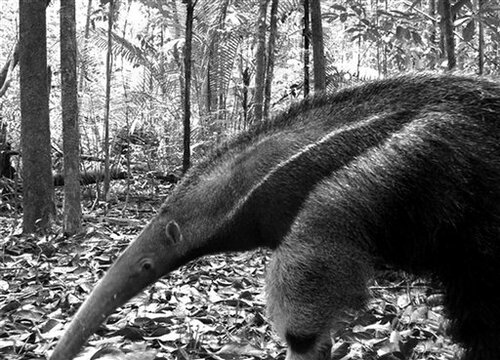
    This image provided by Instituto Nacional de Pesquisas da Amazonia shows a giant anteater in Manaus, Brazil, and is one of almost 52,000 photos of 105 mammal species taken as part of the first global camera trap mammal study by The Tropical Ecology Assessment and Monitoring Network in 7 protected areas across the Americas, Africa and Asia. The cameras were hidden with camouflage and didn't have a visible flash and were heat sensitive so when something warm was nearby, the camera snapped a picture. (AP Photo/Instituto Nacional de Pesquisas da Amazonia/TEAM)
  • Candid Camera Wildlife

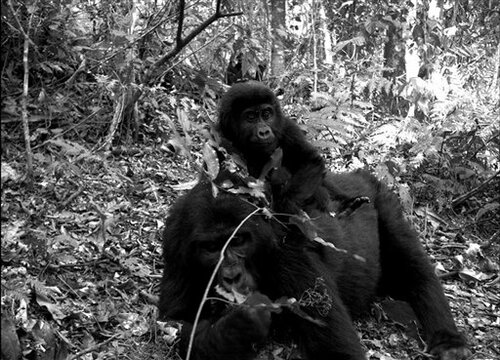
    This image provided by Wildlife Conservation Society/TEAM shows an endangered female mountain gorilla carrying an infant on her back in the Bwindi Impenetrable Forest, Uganda, on Aug. 13, 2010, and is one of almost 52,000 photos of 105 mammal species taken as part of the first global camera trap mammal study by The Tropical Ecology Assessment and Monitoring Network in 7 protected areas across the Americas, Africa and Asia. The cameras were hidden with camouflage and didn't have a visible flash and were heat sensitive so when something warm was nearby, the camera snapped a picture. (AP Photo/Wildlife Conservation Society/TEAM)
  • Candid Camera Wildlife

    This image provided by Conservation International Suriname shows a jaguar in the Central Suriname Nature Reserve, and is one of almost 52,000 photos of 105 mammal species taken as part of the first global camera trap mammal study by The Tropical Ecology Assessment and Monitoring Network in 7 protected areas across the Americas, Africa and Asia. The cameras were hidden with camouflage and didn't have a visible flash and were heat sensitive so when something warm was nearby, the camera snapped a picture. (AP Photo/Conservation International Suriname/TEAM)

Read Next:

Comments (1 Comment)

Add New Comment