



The Daily Edge uses cookies. By continuing to browse this site you are agreeing to our use of cookies. Click here to find out more »
Dublin: 8 °C Wednesday 22 May, 2013

How today is the planet Neptune’s first birthday (kind of)

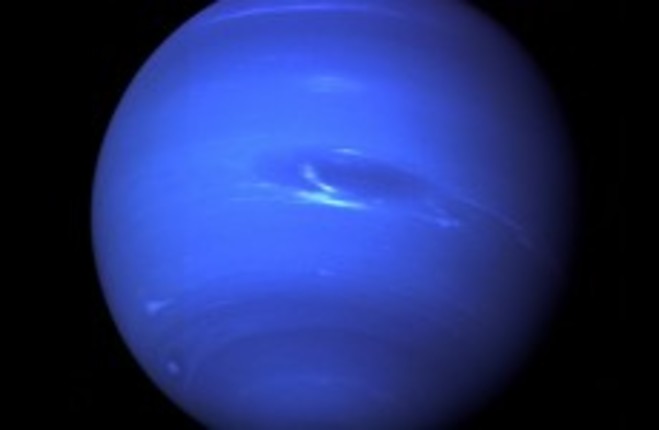
Neptune was first observed from Earth on 24 September 1846. So how does that make today a birthday?

Image: thebadastronomer via Flickr

IN INTER-PLANETARY TERMS, today is the first birthday of the planet Neptune.

The most outlying planet from our sun (now that Pluto has been robbed of its planetary status) was first observed from Earth on 24 September 1846 – becoming the first planet to be ‘deliberately’ discovered based on an expected sighting.

As the BBC News Magazine recounts, the planet Uranus had been classified over 60 years earlier – but its staggered orbit led astronomers to believe that another body must have been exerting a gravitational pull on it.

So they set looking for a body that may have been skewing Uranus’ path – and having spent decades working on a mathematical plan to predict where such a body might have been, it took only an hour to spot a planet where no planet had previously been known.

But how does the date of Neptune’s first observation* make today its birthday? Well, Neptune takes the equivalent of 164.79 Earth years to complete its orbit around the sun – one Neptunian year.

Today, Neptune will occupy exactly the same spot (relative to the sun) that it did when Earthlings discovered it – as exactly one Neptunian year has passed since that date, making today the planet’s first birthday.

Of course, it’s not technically the planet’s birthday – if you’re going by Neptunian years, the planet is 27,307,482 years old; by Earth terms, it’s around 4.5 billion.

Either way, we won’t be sending a cake – because even at the speed of light, it would take four hours to arrive, and when it got there it would instantly be made slightly less appetising by the local temperature: an approximate -218°C.

Still, it gives you an excuse to skip the birthday party…

* No offence to Galileo Galilei, who is credited with observing Neptune twice in 1612 and 1613, but who mistook it for a fixed star in the distance.

Read next:

Comments (6 Comments)

  • More science please.

    Reply
  • Not not NOT #astrology. #ASTRONOMY!!! (I’d explain the difference but this tiny keyboard is killing me.)
    Now, repeat after me: Astronomy, not astrology in the hash tags. Good. :)

    Reply
    • I’ll admit to the unfortunate typo (but not the mix-up – it was intended to be ‘astronomy’ and it was a slip of the fingers). :)

      Technically, though, it’s both… http://en.wikipedia.org/wiki/Planets_in_astrology#Neptune

      Reply
    • Metassus 12/07/11 #

      Technically it’s both only if you subscribe to a pseudoscience that panicked to “fit in” a number of new planets discovered by scientific observation and calculation, and is as exact a science as ECB economics. ;)
      Still, no harm done. My horoscope In last Sunday’s News of the World told me that it’s going to be another great week for me. Did you know I share the same star sign as Rupert Murdoch?

      Reply
    • I’m reminded of a quote from the pilot episode of The Big Bang Theory:
       

      Penny: I’m a Sagittarius, which probably tells you way more than you need to know…

      Sheldon: Yes – it tells us that you participate in the mass cultural delusion that the sun’s apparent position relative to arbitrarily defined constellations at the time of your birth somehow affects your personality.

      Reply
  • Hold on now, so today is it’s Earth birthday.
    Stop pushing your earthly desires on other planets. Leave Neptune alone, look what you scientists did to poor old Pluto, that place’ll never be the same again.

    Reply

Add New Comment